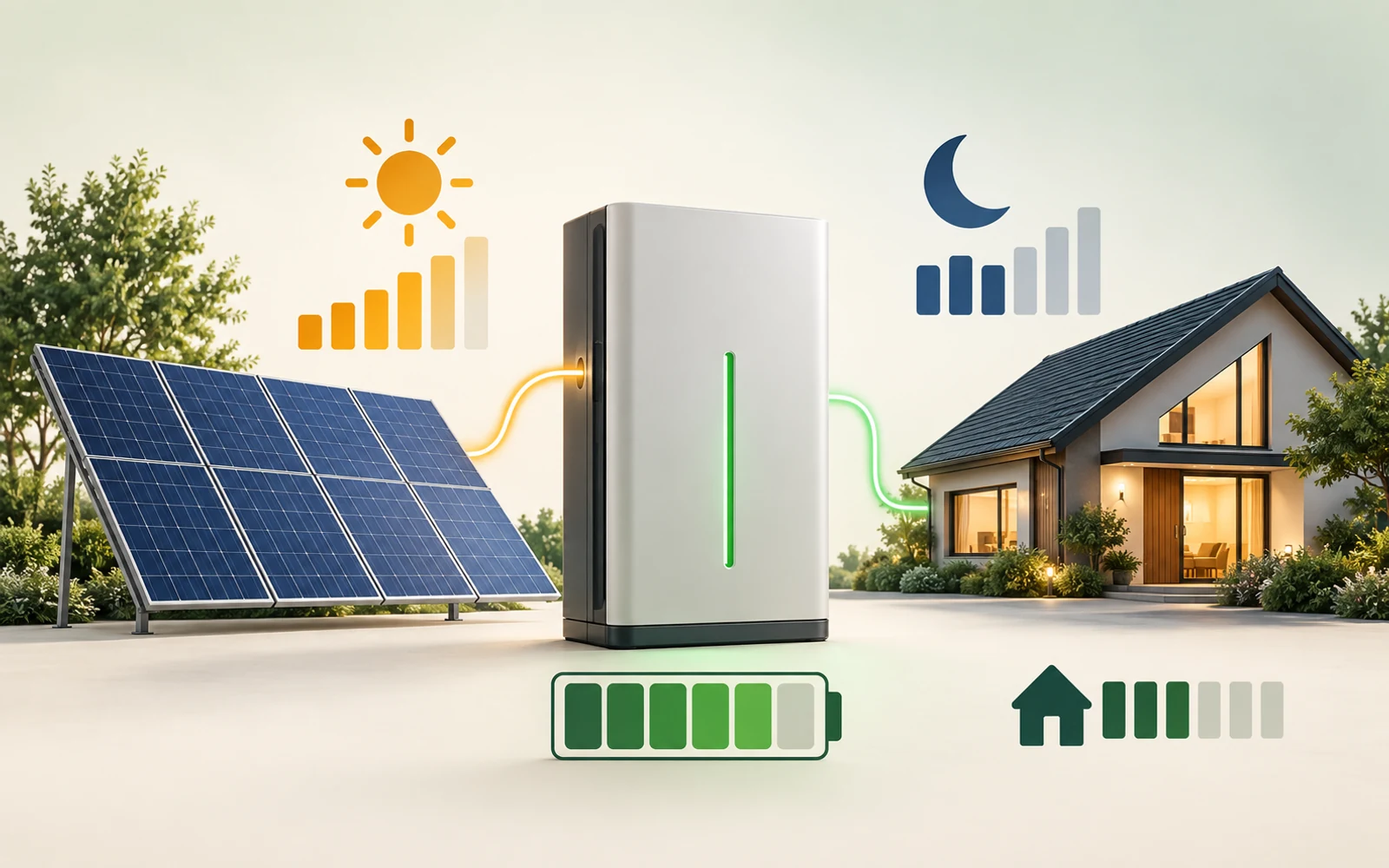
Choosing a solar battery that is too small means dark evenings; choosing one that is too big wastes hundreds of euros. This guide walks through the full sizing method — the same formulas our free solar calculators use — with worked examples and an original price-per-Wh comparison built from live retailer datafeeds.
Step 1: Add up your daily consumption
Everything starts from watt-hours per day (Wh) — power draw multiplied by hours of use. Typical values:
| Appliance | Power | Hours/day | Energy/day |
|---|---|---|---|
| Compressor fridge | 60 W | 24 h (cycling) | ~700 Wh |
| Laptop | 65 W | 4 h | 260 Wh |
| Phones (2x) | 20 W | 2 h | 40 Wh |
| LED lights | 30 W | 5 h | 150 Wh |
| Wi-Fi router | 12 W | 24 h | 290 Wh |
| TV | 100 W | 3 h | 300 Wh |
| CPAP machine | 40 W | 8 h | 320 Wh |
A realistic "essentials" profile (fridge, laptop, phones, lights) lands around 1,150-1,900 Wh per day.

Step 2: Convert consumption into battery capacity
Nameplate capacity is not usable capacity. Two corrections matter:
- Depth of discharge (DoD). LiFePO4 batteries in modern power stations are typically cycled to about 80% to preserve lifespan.
- Safety margin. Inverter losses and cloudy-day reality justify roughly 20% headroom.
The formula:
Battery capacity (Wh) = daily consumption x days of autonomy x 1.2 / 0.8

Step 3: Decide how many days of autonomy you need
| Profile | Daily use | Autonomy | Required capacity |
|---|---|---|---|
| Weekend camping | 500 Wh | 1 day | ~750 Wh |
| Home backup (essentials) | 1,500 Wh | 1 day | ~2,250 Wh |
| Off-grid cabin | 2,000 Wh | 2 days | ~6,000 Wh |
Grid-tied homes rarely need more than one day of autonomy. Off-grid setups should plan for at least two consecutive cloudy days.

Step 4: Match the panel wattage
A battery is only useful if the sun can refill it. Required panel power:
Panel watts = daily consumption / peak sun hours / 0.75
The 0.75 factor covers cable, charge-controller and temperature losses (~25%). At 3.5 peak sun hours (central Europe), refilling 1,500 Wh per day takes about 570 W of panels.
What capacity actually costs in 2026 (original data)
We computed the price per watt-hour from the official AWIN retailer datafeeds (ALLPOWERS in EUR, BLUETTI in US$), snapshot of 13 July 2026, cheapest in-stock variant per model:
| Model | Capacity | Price | Price per Wh |
|---|---|---|---|
| BLUETTI AC2A | 204 Wh | $149 | $0.73/Wh |
| ALLPOWERS VOLIX P300 | 256 Wh | 175 EUR | 0.68 EUR/Wh |
| BLUETTI EB3A | 268 Wh | $199 | $0.74/Wh |
| ALLPOWERS S300 Plus | 288 Wh | 178 EUR | 0.62 EUR/Wh |
| BLUETTI Elite 30 V2 | 288 Wh | $239 | $0.83/Wh |
| ALLPOWERS R600 | 299 Wh | 199 EUR | 0.67 EUR/Wh |
| ALLPOWERS S700 | 604 Wh | 259 EUR | 0.43 EUR/Wh |
| ALLPOWERS R1500 LITE | 1,056 Wh | 424 EUR | 0.40 EUR/Wh |
| ALLPOWERS S1500 PLUS | 1,092 Wh | 549 EUR | 0.50 EUR/Wh |
| BLUETTI AC200P L | 2,304 Wh | $1,099 | $0.48/Wh |
The takeaway: cost per Wh drops sharply with size. Sub-300 Wh stations cost 0.62-0.83 per Wh, while the 600-1,100 Wh class drops to 0.40-0.50 per Wh. If your budget allows, buying one size up is usually better value than buying twice.
Methodology: prices read directly from the retailers' AWIN product feeds on 2026-07-13; variant rows collapsed to the cheapest in-stock offer per model; capacity taken from the manufacturer's Wh rating. Prices change - use the linked product pages for live values.
Common sizing mistakes
- Sizing on nameplate Wh instead of usable Wh (DoD) — the #1 cause of undersized systems.
- Ignoring inverter overhead — an idle inverter can burn 5-15 W around the clock.
- Forgetting surge loads — a fridge compressor briefly draws 3-4x its rated power; check the station's surge rating, not just capacity.
- Buying battery without checking solar input limits — a big battery with a 200 W max solar input recharges painfully slowly.
Do the math for your own setup
Plug your numbers into the free battery capacity calculator or answer four questions in the Solar Finder to get product recommendations sized to your usage.