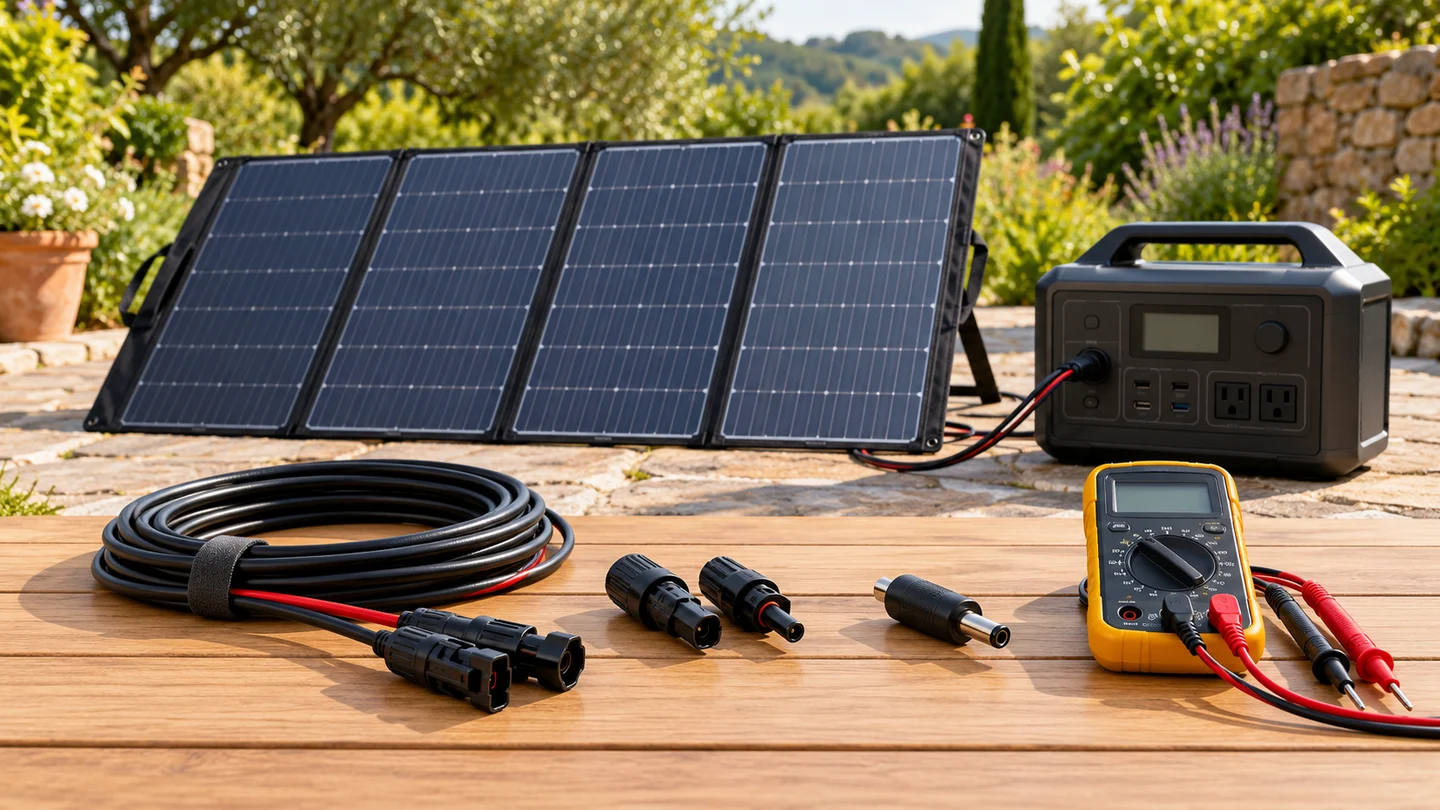
A 200 W panel is not automatically a match for a power station with a 200 W solar input. Wattage is only one check. Voltage, current and the connection must fit too.
Use the manuals for your exact station and panel models. This is a buying checklist, not wiring instructions for a fixed installation.
Start with the station's solar input
Write down the permitted PV voltage range, maximum input current, maximum input power and required connector. Check whether the limits apply to each input separately. AC charging specifications do not replace solar input specifications.
BLUETTI's official FAQ lists open-circuit voltage, current, power limits and the connector among the checks for third-party panels. A shared brand name does not replace checking the exact models.

Check open-circuit voltage
Panel specifications can show operating voltage and open-circuit voltage, usually marked Voc. Use the value required by the station manual when checking its upper voltage limit. A hypothetical panel with a 24 V operating voltage and a 30 V Voc fails a stated 28 V maximum, even though the operating figure looks acceptable.
Check cold-weather guidance too: Voc can rise as temperature falls. A combination near the voltage ceiling needs careful verification. Do not assume the controller will safely correct an excessive voltage. Victron’s installation manual explains why Voc and temperature must be considered together; apply your own station’s limits, not that controller’s ratings.

Check current and the connection separately
Compare current specifications with the station's documented limits, using the values required by its manual. An adapter changes the plug; it does not make voltage, current or polarity correct.
Before ordering, confirm which cable is included and which adapter is needed. Ask the manufacturer to confirm compatibility if the documentation is ambiguous. Avoid selecting cables solely because the connectors appear to fit.

Extra panels change the calculation
Combining panels changes the electrical characteristics. Series and parallel arrangements affect voltage and current differently. Check the complete configuration against the manual's limits rather than checking one panel and multiplying its watts.
If the manufacturer does not document your intended arrangement, get a confirmed configuration before buying extra panels. Connector compatibility alone is not approval for the setup.
Estimate charging from average input
A panel rating does not promise that output throughout the day. Angle, shading, weather and sunlight affect the energy reaching the station.
Suppose your setup averages 120 W into the station and you want to replenish 600 Wh. The simple division is 600 ÷ 120 = five hours. This is an illustrative energy calculation before additional losses, changing conditions and charging behaviour, not a guaranteed charging time. Devices running during charging use part of the incoming energy.
Keep these details on your shortlist
- Exact station and panel models, with their manuals.
- PV input range and panel Voc, including temperature guidance.
- Current and power limits for the intended configuration.
- Connector, polarity, included cable and any approved adapter.
- Panel dimensions, weight, warranty and the complete kit price.
Save the specifications with your shortlist. A slightly less powerful panel that meets every limit is a more useful candidate than a larger panel whose compatibility is unclear.
For battery capacity, read our watts and watt-hours guide. For a wider overview, visit the solar energy section.