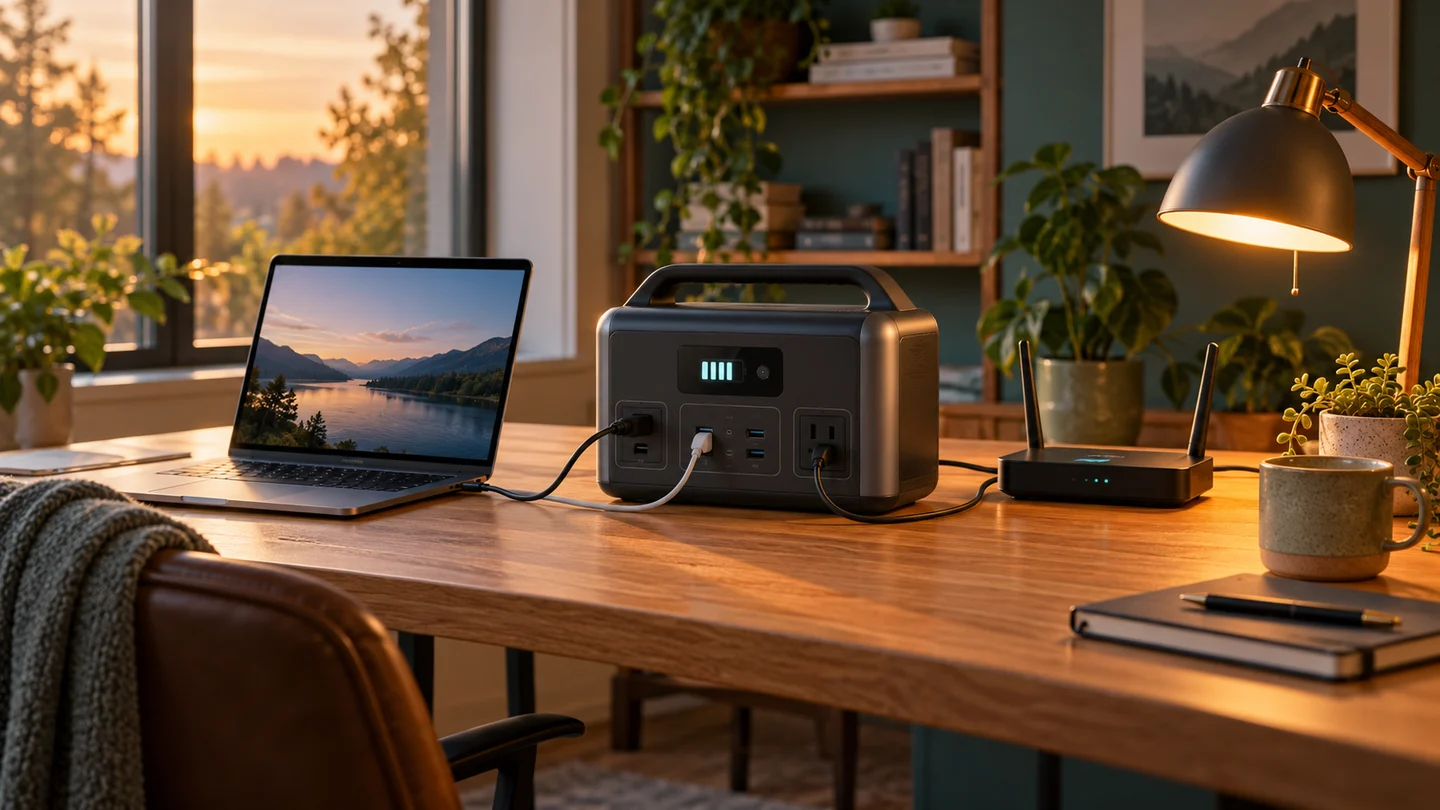
A power station can run your laptop and still fall short of a working day. Before comparing deals, check two separate specifications: watts describe the load it can support, while watt-hours describe stored energy.
The calculations below are illustrative examples, not results of hands-on ClipRaptor tests.
Watts versus watt-hours
A device drawing a constant 60 W uses 60 Wh in one hour. A 1,000 Wh battery and a 1,000 W continuous AC output answer different questions: how much energy is stored, and how much power the inverter can supply. EcoFlow explains the terminology in its official specifications guide.
Add the running power of devices you will use together. Check startup requirements separately for appliances with motors. A peak output figure does not mean a station can sustain that load for hours.

Calculate the energy you need
Imagine a laptop averaging 60 W, a router averaging 10 W and a lamp averaging 5 W. These are example values, not universal device ratings. Their combined load is 75 W. Four hours requires 75 × 4 = 300 Wh delivered to the devices.
Measure your equipment with a suitable plug-in meter where possible. A charger label can describe maximum output rather than ordinary laptop consumption. For a refrigerator that cycles on and off, measure energy over a representative period instead of relying on one instantaneous reading.

Include losses and a reserve
For planning, suppose 80% of nominal battery energy reaches the loads. This is an illustrative assumption, not a measured efficiency for any model. A 512 Wh station would deliver roughly 410 Wh in this scenario: about 5.5 hours at 75 W. A 1,024 Wh station would give about 10.9 hours under the same assumptions.
Actual runtime depends on inverter consumption, output type, temperature, battery condition and changing loads. Low-power devices can make standby consumption especially relevant. Compare the manufacturer's guidance with your intended setup and keep a reserve.

Automatic backup needs another check
If you need the station to take over during a power cut, verify the exact model's transfer time and the appliance's requirements. EPS or UPS labels alone do not establish compatibility. EcoFlow's EPS instructions document a transfer delay and restrictions for devices requiring a zero-millisecond UPS. Consult the manual for the model you intend to buy.
Use the station's own outlets according to its instructions. A portable station is not automatically a whole-home backup installation.
Before choosing a model
- List your essential devices and their measured or documented consumption.
- Multiply average watts by the hours required.
- Allow for losses and a practical reserve.
- Check continuous output, startup requirements and the ports you need.
- Compare weight, charging options, warranty and the final delivered price.
For a laptop and router, carrying weight may matter more than a large inverter. For heating appliances, output power and short runtime can become the main limits. Decide which job matters before paying for extra capacity.
Continue with our solar panel compatibility checklist, explore the power station selector, or visit the solar energy section.